
Pathway lighting
-
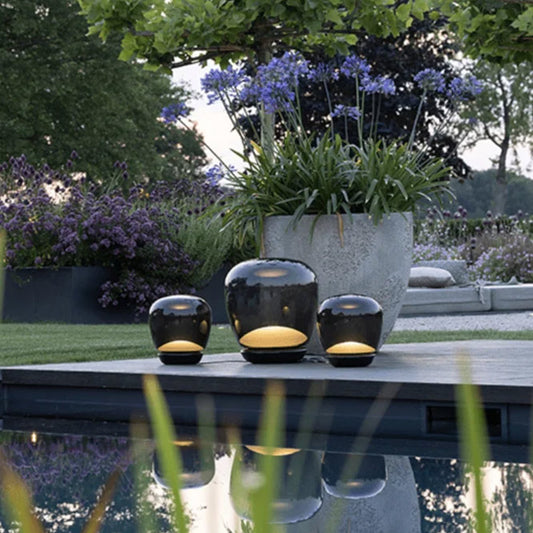
in-lite | VOQUE | Bollards
Regular price €395,70Regular price

Which pathway lighting works best for your garden?
Different sections of a garden path can require different light effects. How frequently the route is used, its width, and nearby planting or garden features determine which type of fixture is most appropriate. Use the table below to match common pathway situations with suitable in-lite lighting.
| Path situation | Lighting approach | Why it works | in-lite examples |
|---|---|---|---|
| Main garden path | Modern and practical in-lite bollards | Provides useful illumination from beside the route and makes the path clearly readable | ACE ACE HIGH EVO EVO LOW |
| Path through planting | Low and discreet in-lite bollards | Combines orientation with soft illumination of nearby grasses and foliage | MINI SWAY LOW SWAY LOW LIV LOW |
| Path where the fixture is part of the design | Unique in-lite bollards with a distinct design | Adds a distinctive design element alongside the route during the day and after dark | VOQUE DISC |
| Minimalist garden path | Slim in-lite bollards | Provides light beside the route with a narrow, understated fixture | NAIL |
| Paved path or suitable hard surface | in-lite recessed lights | Defines the direction of the route without adding a standing fixture beside it | PUCK HYVE FUSION DOT |
Should you choose bollards or recessed lights?
Choose bollards when you want to illuminate the path from beside the route. Because the light source sits above ground level, these fixtures can illuminate part of the walking surface while also interacting with nearby planting. They are great for paths bordered by soil, gravel, or planted areas.
Choose recessed lights when you want the fixtures to remain visually discreet. Integrated into suitable paving, decking, or other surfaces, they are very effective as orientation lighting and for defining the direction or edges of a path. Always check that the surface and underlying construction are suitable for the specific recessed fixture.
Where should you position lights along a garden path?
Position pathway lights where they help make the shape and direction of the route easy to recognise. Prioritise bends, intersections, entrances, and transitions between different surfaces rather than automatically placing fixtures at identical intervals along the entire path.
With bollards, alternating fixtures between the two sides can create a more natural rhythm than two parallel rows. A narrow path may only need lighting along one side. Recessed lights can be positioned along the edge of suitable paving to define the route while keeping the central walking surface free.
How many lights do you need along a pathway?
As a good starting point, place approximately one pathway light every 2 to 3 metres. The ideal spacing depends on the brightness and light distribution of the fixture, the shape of the path, and how much light the route requires.
Before completing the installation, it can be useful to mark the proposed positions and assess the spacing after dark. This allows you to check for dark sections and adjust the layout before the fixtures and cabling are permanently positioned.
Benefits of good pathway lighting
-
Makes garden routes easier to navigate after dark
A clear sequence of light points helps you follow the path naturally from one area of the garden to another. -
Creates an inviting route through the garden
Illuminated paths encourage the eye to travel deeper into the garden, connecting terraces, seating areas, sheds, and other destinations. -
Keeps paths visually connected to the landscape
Carefully positioned lighting can reveal nearby planting and small garden features, preventing the route from appearing as just an isolated strip of light.
Buy in-lite pathway lighting at Gardenlightsstore.com
Explore in-lite pathway lighting at Gardenlightsstore.com, from bollards in different heights and designs to discreet recessed lights for orientation. With over 20 years of experience with in-lite, our lighting specialists can help you choose the right fixtures, spacing, and positioning for your pathway.
Orders over €100 qualify for free shipping across the EU, and all products come with a 5-year warranty.
Frequently asked questions
How do I make a lighting plan for my garden?
A garden lighting plan is a simple sketch that shows where every outdoor light will be installed before you buy any fixtures. A good lighting plan improves safety, highlights key features such as trees and pathways, and helps you choose the correct transformer and number of fixtures. Most gardens can be planned in five simple steps and within an hour.
What's the difference between functional and atmospheric lighting?
Functional lighting keeps you safe; think steps, doorways, and paths. Atmospheric lighting is there to set the mood, like a tree lit from below or a soft glow near your terrace.
Can I install in-lite garden lighting myself?
Yes. The in-lite 12V system is designed for easy installation without any specialist knowledge. Using Easy-Lock connectors, most homeowners can install or expand their lighting system themselves. Always follow the installation instructions and ensure the transformer is installed in a dry, well-ventilated location.
Can I expand my garden lighting system later?
Yes. One of the advantages of the in-lite 12V system is that it can easily be expanded over time. You can start with lighting for your patio and pathways, then add fixtures for trees, borders, or other garden features as your lighting plan evolves.
Does an in-lite ground cable need to be buried?
An in-lite ground cable can be safely concealed beneath a layer of soil. Because the in-lite system operates on 12V low voltage, the cable does not need to be installed like a conventional 230V electrical cable. Always follow the official in-lite instructions when routing and concealing the cable in your garden.
Can I change the light effect of my fixture?
Yes, selected in-lite fixtures can be combined with accessories that adjust their appearance or light effect. Available options depend on the specific fixture and can include lenses, shutters and other design accessories. Check the page of the appropriate series to see which accessories match the products.
How many in-lite lights can I connect to one transformer?
There is no fixed number of in-lite lights you can connect to one transformer. The limit depends on the combined VA of the fixtures rather than the number of lights. Add together the VA of all connected fixtures and make sure the total remains below the maximum VA capacity of your HUB or SMART HUB.
How do I choose the right height for an in-lite bollard?
Choose the height of your bollard according to its surroundings and the role you want it to play in the garden. Lower models work well beside low planting and where you want the fixture to remain discreet, while taller bollards can remain more visible among higher planting. Several in-lite series are available in different heights, allowing you to use a consistent design across different parts of the garden.
Can I use in-lite bollards between planting?
Yes. Bollards from in-lite can be used between plants to combine orientation lighting with atmosphere. Consider the height and density of the surrounding planting when choosing the fixture. Lower bollards work well with low planting, while taller models remain more visible among grasses, shrubs and other higher planting.