
in-lite BLINK
-
in-lite | BLINK Dark | Wall lights
Regular price €89,26Regular price -
in-lite | BLINK Rose Silver | Wall lights
Regular price €89,26Regular price -
in-lite | BLINK White | Wall lights
Regular price €89,26Regular price

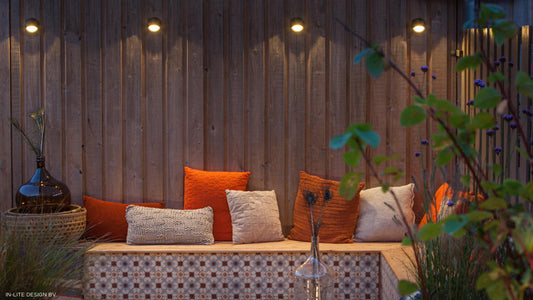

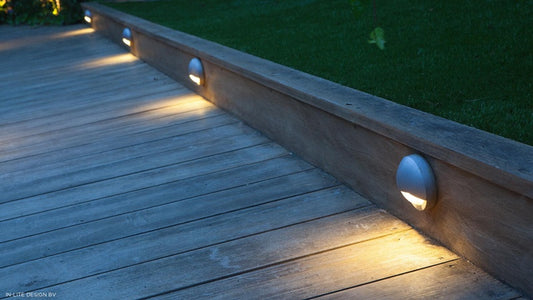

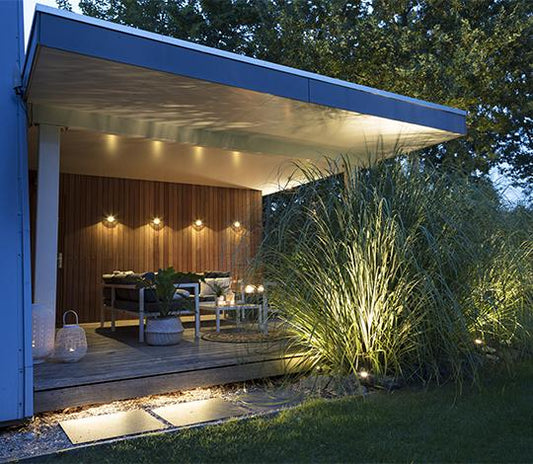
For specific installations, the in-lite FIX 1 provides a concealed mounting solution for the BLINK. The mounting anchor is installed between wall sections or masonry, allowing the wall light to be securely fixed while keeping the mounting point neatly out of sight.
Why choose the in-lite BLINK?
-
Two interchangeable lenses
The BLINK comes with a matt and a transparent lens, allowing you to choose between a softer, diffused light effect and a clearer, more directional beam. -
Compact wall light
With a diameter of 100 mm and a depth of 48 mm, the BLINK provides subtle wall lighting without visually dominating the surface. -
Ideal for subtle orientation lighting
The warm white light has a reach of approximately 1,5 metres, making the BLINK suitable for illuminating low walls, steps, terraces and paths. -
Three coordinated finishes
The BLINK is available in Dark, Rose Silver and White, giving you a variety of finishes to complement different walls and materials.
Buy the in-lite BLINK at Gardenlightsstore.com
Explore the in-lite BLINK collection at Gardenlightsstore.com. With over 20 years of experience with in-lite, our lighting specialists can help you choose the right finish and integrate the BLINK into your 12V garden lighting plan.
Orders over €100 qualify for free shipping across the EU, and all products come with a 5-year warranty.
Frequently asked questions
How many garden lights do I need?
This very much depends on the size of your garden, the number of features (walls, trees, borders, etc.), and your preferences. Most medium-sized gardens use somewhere between 8 and 15 fixtures, split between functional and atmospheric lighting. Larger gardens often need more. You can always buy a smaller amount of fixtures first to test how they look and then expand with more later.
What's the difference between functional and atmospheric lighting?
Functional lighting keeps you safe; think steps, doorways, and paths. Atmospheric lighting is there to set the mood, like a tree lit from below or a soft glow near your terrace.
Can I connect multiple in-lite fixtures to one ground cable?
Yes. Multiple in-lite fixtures can be connected to the same 12V ground cable. Each fixture is connected at the required position along the cable using an Easy-Lock connector. The total capacity of your lighting system (VA) must remain within the capacity of the in-lite transformer.
How far apart should in-lite wall lights be?
For general wall and fence lighting, spacing wall lights around 1,5 to 2 metres apart is a useful starting point. The ideal distance depends on the fixture's light distribution, mounting height, and the effect you want to create. Wider spacing creates more distinct pools of light, while closer spacing produces a more continuous lighting effect.
At what height should in-lite wall lights be installed?
For general wall and ambient lighting, a mounting height of around 1,5 to 1,8 metres above ground level is a useful starting point. Low-level wall lights used for paths, steps, or orientation lighting can be positioned much lower, typically around 30 to 45 cm above the ground. Always consider the fixture's light distribution and potential glare when choosing the final mounting height.
Should garden lighting be symmetrical?
Not necessarily. Asymmetrical lighting often creates a more natural and layered effect, particularly around planting, trees, and informal garden paths. Symmetrical lighting can work well around formal entrances, façades, or straight paths where a balanced appearance suits the architecture and garden design.
How many in-lite lights can I connect to one transformer?
There is no fixed number of in-lite lights you can connect to one transformer. The limit depends on the combined VA of the fixtures rather than the number of lights. Add together the VA of all connected fixtures and make sure the total remains below the maximum VA capacity of your HUB or SMART HUB.
Why has my in-lite fixture stopped working?
An in-lite fixture can stop working for several reasons. The most common causes are a loose Easy-Lock connection, a disconnected ground cable, a transformer without power or a faulty fixture. Before replacing any components, check each part of the system to identify the source of the problem.