Frequently asked questions (FAQ)
No matching questions found.
Planning
How do I make a lighting plan for my garden?
A garden lighting plan is a simple sketch that shows where every outdoor light will be installed before you buy any fixtures. A good lighting plan improves safety, highlights key features such as trees and pathways, and helps you choose the correct transformer and number of fixtures. Most gardens can be planned in five simple steps and within an hour.
Read more: Comment créer un plan d’éclairage pour votre jardin →
How many in-lite lights can I connect to one transformer?
There is no fixed number of in-lite lights you can connect to one transformer. The limit depends on the combined VA of the fixtures rather than the number of lights. Add together the VA of all connected fixtures and make sure the total remains below the maximum VA capacity of your HUB or SMART HUB.
What is the difference between an in-lite HUB and SMART HUB?
A standard in-lite HUB provides easy transformer control, while a SMART HUB can be controlled through the in-lite app and offers individually controlled cable outputs and support for in-lite smart fixtures. Your choice therefore depends on both the required VA capacity and the level of control you want.
How do I calculate the VA required for my in-lite transformer?
Add together the VA values of all in-lite fixtures you plan to connect. The combined VA must remain below the maximum capacity of the transformer. For example, a HUB 75 or SMART HUB 75 supports up to 75 VA, while a SMART HUB 150 supports up to 150 VA. We recommend allowing spare capacity if you plan to expand your lighting later.
What is outdoor lighting from in-lite?
Outdoor lighting from in-lite is designed around its unique 12V low-voltage system for illuminating gardens and other outdoor spaces. The system combines a transformer, ground cable and fixtures connected with Easy-Lock connectors. The range includes spotlights, recessed lights, wall lights, bollards, pendant lights and other fixtures for functional and atmospheric lighting.
How many garden lights do I need?
This very much depends on the size of your garden, the number of features (walls, trees, borders, etc.), and your preferences. Most medium-sized gardens use somewhere between 8 and 15 fixtures, split between functional and atmospheric lighting. Larger gardens often need more. You can always buy a smaller amount of fixtures first to test how they look and then expand with more later.
Do I need a professional to make a garden lighting plan?
No. A pen, paper, and this guide are enough for most gardens. If your garden is large or complex, we're happy to help you work through it.
Read more: Comment créer un plan d’éclairage pour votre jardin →
Design
What is the difference between a narrow and wide spotlight beam?
A narrow beam concentrates light on a smaller area, making it suitable for highlighting a specific feature more precisely. A wider beam spreads the light across a larger area and can illuminate more of a tree, plant or other garden feature. The best beam depends on the size and shape of the feature and the effect you want to create.
Can I change the light effect of my fixture?
Yes, selected in-lite fixtures can be combined with accessories that adjust their appearance or light effect. Available options depend on the specific fixture and can include lenses, shutters and other design accessories. Check the page of the appropriate series to see which accessories match the products.
Which type of garden light is best for trees?
Outdoor spotlights are generally the best choice for illuminating trees because they allow you to direct the beam exactly where it's needed. The ideal beam angle depends on the height and width of the tree, so larger trees often require a different lighting approach than smaller ornamental trees.
What's the difference between functional and atmospheric lighting?
Functional lighting keeps you safe; think steps, doorways, and paths. Atmospheric lighting is there to set the mood, like a tree lit from below or a soft glow near your terrace.
Choosing Fixtures
How do I choose the right outdoor spotlight for my garden?
Choose an outdoor spotlight based on what you want to illuminate, the size of the feature and the lighting effect you want to create. Compact spotlights are suitable for smaller plants and shrubs, while larger features such as mature trees may require a more powerful spotlight. For water features, choose a fixture specifically designed for that application.
Are all in-lite accessories compatible with every fixture?
No. Many in-lite accessories are designed for specific fixtures, product series, or system components. Always check the compatibility information on the accessory or fixture product page before ordering. If you're unsure, our lighting specialists can help you find the correct accessory for your in-lite product.
What is the difference between in-lite 14/2 and 10/2 cables?
The main difference is the amount of copper inside the cable and the maximum linear cable distance. The 14/2 cable can be used for linear cable runs up to 40 metres. The thicker 10/2 cable contains more copper and supports linear cable runs up to 80 metres, making it suitable for bigger installations.
How do I choose the right transformer for my garden lighting?
The right transformer depends on the total VA required by your garden lighting. Add together the VA rating of all the fixtures in your lighting plan and choose an in-lite transformer with sufficient capacity. Conveniently, the names correspond to their maximum VA (HUB 75 = 75 VA, SMART HUB 150 = 150 VA). Don't forget to allow some room for future expansion. This avoids the hassle of having to replace the transformer in the future.
Installation
Can I install an in-lite transformer outdoors?
Yes. An in-lite transformer can be installed outdoors, but it must be mounted correctly and protected from the weather. in-lite recommends mounting the transformer at least 50 cm above the ground and away from direct rainfall. If no sheltered location is available, use a compatible in-lite PROTECTOR for your HUB model.
Can I use another cable for in-lite garden lighting?
in-lite recommends using its own cables with in-lite garden lighting. The Easy-Lock contact points and cable guide are specifically designed for the dimensions and outer layer of in-lite cables, helping ensure proper contact and current conduction. Using a non-in-lite cable may also affect the manufacturer's warranty.
Does an in-lite ground cable need to be buried?
An in-lite ground cable can be safely concealed beneath a layer of soil. Because the in-lite system operates on 12V low voltage, the cable does not need to be installed like a conventional 230V electrical cable. Always follow the official in-lite instructions when routing and concealing the cable in your garden.
Can I connect multiple in-lite fixtures to one ground cable?
Yes. Multiple in-lite fixtures can be connected to the same 12V ground cable. Each fixture is connected at the required position along the cable using an Easy-Lock connector. The total capacity of your lighting system (VA) must remain within the capacity of the in-lite transformer.
Can I expand my garden lighting system later?
Yes. One of the advantages of the in-lite 12V system is that it can easily be expanded over time. You can start with lighting for your patio and pathways, then add fixtures for trees, borders, or other garden features as your lighting plan evolves.
Can I install in-lite garden lighting myself?
Yes. The in-lite 12V system is designed for easy installation without any specialist knowledge. Using Easy-Lock connectors, most homeowners can install or expand their lighting system themselves. Always follow the installation instructions and ensure the transformer is installed in a dry, well-ventilated location.
Smart Lighting
Which smart accessories can I add to my in-lite system?
If your in-lite system uses a SMART HUB transformer, you can add in-lite smart accessories to expand its functionality. This allows you to add compatible smart control and automation options to your outdoor lighting system. When adding smart fixtures, always check which in-lite lights are compatible with the smart functionality you want to use. Compatibility can vary between fixtures, so check the relevant product specifications before expanding your system.
Warranty & Support
When should I submit a warranty claim?
If you've properly checked the transformer, ground cable and Easy-Lock connection and the fixture still doesn't work, it may be defective. Keep your proof of purchase and make sure the system has been installed according to the official in-lite instructions before submitting a warranty claim. If you're uncertain about anything, you can always contact us for additional help.
Troubleshooting
Can one faulty fixture affect the rest of my garden lighting?
In most cases, a single faulty fixture will not stop the rest of the system from working. However, a damaged cable or an incorrectly installed connector can affect multiple fixtures connected to the same cable. Checking the system step by step will help you locate the issue easily.
How can I check if my transformer is working?
First, make sure the transformer is connected to a working power outlet and that the reset button hasn't been triggered. Then check that the low-voltage cable is securely connected. If the transformer isn't supplying power, none of the connected fixtures will operate.
How do I know if my Easy-Lock is faulty?
The easiest way to test an Easy-Lock is by connecting a known working Easy-Lock to the fixture that isn't working. If the fixture switches on, the original Easy-Lock is likely causing the problem. Also inspect the connector for bent pins or an incorrectly positioned cable.
Why has my in-lite fixture stopped working?
An in-lite fixture can stop working for several reasons. The most common causes are a loose Easy-Lock connection, a disconnected ground cable, a transformer without power or a faulty fixture. Before replacing any components, check each part of the system to identify the source of the problem.
Nos favoris
-
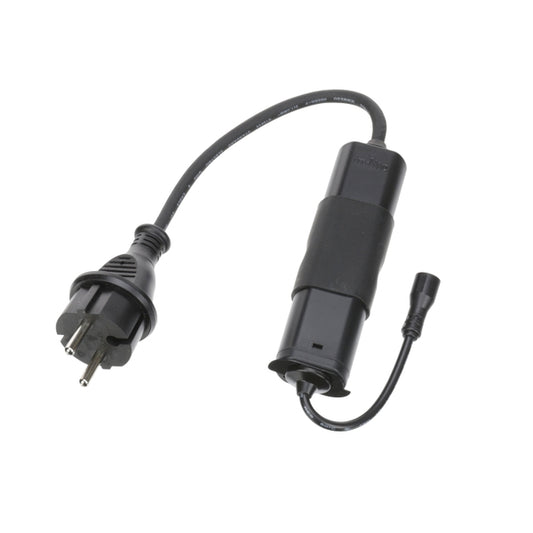
in-lite ADAPTER | Accessoires
Prix habituel €68,42Prix habituel -
in-lite | CÂBLE 10/2 | 20 capuchons de câble | Accessoires
Prix habituel €5,95Prix habituel -
in-lite | CÂBLE 14/2 | 20 capuchons de câble | Accessoires
Prix habituel €5,95Prix habituel